

Protecting Your Child's Smile — Starting From the Very First Visit
Preventive dental care is the single most effective — and most cost-effective — investment DC and McLean families can make in their child's long-term oral health.
At Beverly Pediatric Dentistry, preventive care is not a single service — it is the philosophy behind everything we do. Every routine visit, every fluoride treatment, every sealant placed, and every orthodontic evaluation is designed with one goal: keeping your child's teeth healthy enough that they need as little treatment as possible, now and for the rest of their life.
Dr. Maryam Mohammadi has practiced pediatric dentistry in Washington, DC and McLean, Virginia for over 30 years. In that time, the single most consistent observation is this: children who receive regular preventive care have fewer cavities, simpler treatment histories, lower lifetime dental costs, and a fundamentally different relationship with dental care than children who only visit the dentist when something hurts.
Most parents associate a dental checkup with a cleaning. That's part of it — but it's the visible part of something much more comprehensive.
At every routine visit at Beverly Pediatric Dentistry, Dr. Mohammadi is:
-
Evaluating teeth for early decay that produces no symptoms yet
-
Monitoring jaw and bite development for orthodontic concerns that are far simpler to address early
-
Checking for signs of grinding that parents often don't notice at home
-
Assessing gum health and soft tissue
-
Reviewing dietary habits and home care with parents
-
Removing plaque and tartar buildup that brushing alone cannot reach
The cleaning is what children notice. The rest is what determines whether they arrive at adulthood with a simple dental history or a complicated one.
Why Preventive Dentistry Matters More in Childhood Than at Any Other Stage
The habits, patterns, and dental history established in childhood follow a person for life. A child who develops a cavity that progresses to a pulpotomy and crown has a more complex dental history at age 8 than they should. A child who loses a baby tooth prematurely due to untreated decay may need orthodontic treatment in adolescence to correct the crowding that resulted. A child whose dental anxiety goes unaddressed becomes an adult who avoids care — allowing problems to compound silently for years.
Preventive dentistry interrupts this cycle at every stage. It catches problems when they are smallest and simplest. It strengthens teeth against the conditions that cause decay. It monitors development so that issues are identified while they can still be corrected easily. And it builds the kind of positive, comfortable relationship with dental care that supports a lifetime of good oral health.
What Preventive Dental Care Includes at Beverly Pediatric Dentistry
The foundation of preventive care is the routine checkup — recommended every six months for most children from the first birthday onward.
A professional cleaning removes plaque and tartar from areas that brushing and flossing consistently miss — particularly along the gumline and between teeth. Even children with excellent home care habits accumulate buildup in these areas over time. Without regular professional removal, that buildup creates the conditions for decay and gum disease.
The clinical exam that accompanies each cleaning is equally important. Dr. Mohammadi evaluates not just the visible surfaces of your child's teeth, but their gum health, bite alignment, jaw development, and signs of grinding or early orthodontic concerns. Digital X-rays, taken when indicated, reveal decay developing between teeth and below the gumline — areas invisible to the naked eye where cavities often begin.
What this catches in practice: a cavity that is invisible on the surface and produces no symptoms, identified on X-ray at a routine visit and treated with a simple filling — before it progresses to the nerve and requires a pulpotomy.
Tooth enamel — the hard outer layer that protects each tooth — is constantly under attack from the acid produced by bacteria in the mouth. Every time a child eats or drinks something containing sugar or carbohydrates, bacteria produce acid that temporarily weakens enamel. Saliva naturally remineralizes enamel between these acid attacks — but in children with higher cavity risk, frequent snacking, or diets high in sugar, this balance tips toward decay.
Fluoride accelerates and strengthens remineralization — making enamel more resistant to acid attack and significantly reducing cavity risk. Professional fluoride treatments, applied in office in a matter of minutes, deliver a concentration of fluoride that toothpaste alone cannot replicate. For children at moderate to high cavity risk, they are not optional maintenance — they are essential protection.
Common parent question: Is fluoride safe for my child?
Yes. Fluoride has been studied extensively for over 75 years and has an established safety record at the concentrations used in professional dental treatments and fluoridated water. The American Academy of Pediatrics, the American Dental Association, and the American Academy of Pediatric Dentistry all recommend fluoride as a safe and effective tool for cavity prevention in children.
The chewing surfaces of back molars — particularly the first and second permanent molars that erupt around ages 6 and 12 — have deep grooves and pits where food and bacteria accumulate. These grooves are often too narrow for toothbrush bristles to clean effectively, making them the most cavity-prone surfaces in a child's mouth. The majority of childhood cavities form in exactly these locations.
Dental sealants are a thin protective coating applied to these surfaces, physically sealing out the food and bacteria that cause decay. The application is quick, comfortable, and requires no drilling or anesthesia. Studies consistently show that sealants reduce cavity risk in treated teeth by up to 80% and last 3–5 years before needing reapplication. For a child who has shown any susceptibility to cavities, sealants are one of the highest-value preventive tools available.
The American Academy of Pediatric Dentistry recommends an orthodontic evaluation by age 7. This recommendation exists because certain bite and jaw development issues — crossbites, significant crowding, jaw size discrepancies — are dramatically simpler to correct when identified early, while the jaw is still actively growing and responding to treatment.
At Beverly Pediatric Dentistry, Dr. Mohammadi monitors orthodontic development at every routine visit. When early intervention is appropriate, it is recommended at the right time — not prematurely, and not delayed until problems have compounded.
What early identification prevents in practice: a child with moderate crowding identified at age 7, treated with a palate expander over 12 months, who avoids the need for tooth extraction and complex multi-year orthodontic treatment at 14. The same crowding, left unaddressed, becomes significantly more expensive and time-consuming to correct.
Preventive dentistry extends beyond the dental office. What a child eats, how often they eat it, how they brush, and whether they floss all directly determine their cavity risk between visits.
At every preventive appointment, Dr. Mohammadi provides personalized guidance based on your child's specific risk factors — not generic advice, but recommendations tailored to what she observes at each visit. Parents leave with a clear understanding of what their child's teeth are vulnerable to and what they can do about it at home.
When Early Decay Is Found — A Conservative Option Worth Knowing About
Prevention is the goal — but when early decay is identified before it requires drilling, Beverly Pediatric Dentistry offers Silver Diamine Fluoride (SDF). SDF is a liquid applied directly to the affected area that stops cavity progression without drilling or anesthesia. For young children or anxious patients, it bridges the gap between prevention and traditional treatment — addressing decay at its earliest stage with minimal intervention and no recovery time.

When Should Preventive Care Begin?
From birth: Even before teeth appear, gentle gum cleaning after feedings establishes early oral hygiene habits and removes bacteria from gum tissue.
By the first birthday: The American Academy of Pediatric Dentistry recommends a child's first dental visit by age 1 or within 6 months of the first tooth appearing — whichever comes first. Early visits establish a dental home, allow Dr. Mohammadi to assess development and risk factors, and begin building the child's comfort with dental care before any treatment is ever needed.
Every 6 months: Routine checkups and cleanings from the first visit onward, adjusted to every 3–4 months for children with higher cavity risk.
By age 7: Orthodontic evaluation to identify any developing concerns while intervention is still simple.
Through the teen years: Preventive needs change as children grow — permanent molars erupt, orthodontic treatment may be underway, dietary habits shift, and cavity risk evolves. Consistent preventive care through adolescence protects the permanent teeth that will last a lifetime.
The Real Case for Prevention
Preventive care is sometimes perceived as an expense. In reality it is the mechanism that prevents far larger expenses later.
Here is what the same cavity costs at different stages:
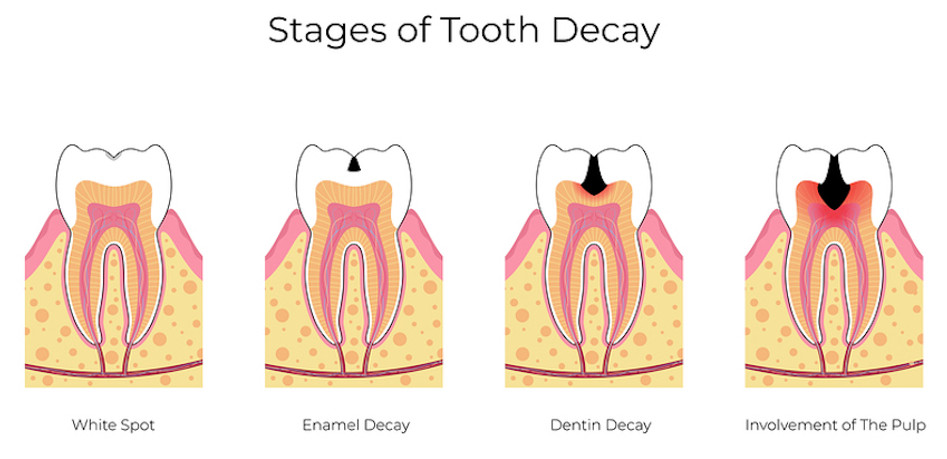
Stage 1 — Caught at a routine checkup
Early decay confined to enamel. Treated with a simple tooth-colored filling.
One appointment. Minimal discomfort. Often no anesthesia needed.
Stage 2 — Left untreated 6–12 months
Decay has reached dentin. Larger filling needed with local anesthetic.
More tooth structure lost. More involved procedure.
Stage 3 — Decay reaches the pulp
Pulpotomy (baby root canal) plus stainless steel crown needed.
Multiple appointments. Sedation often required for anxious children.
Stage 4 — Infection or abscess develops
Extraction plus space maintainer to preserve room for the permanent tooth.
Emergency visits. Child arrives in pain before treatment even begins.
Stage 5 — Premature tooth loss without space management
Surrounding teeth drift into the empty space. Permanent tooth has no room to erupt properly.
Orthodontic correction required — braces, expanders, or aligners.
One cavity. Five possible outcomes. A cost range from $150 to over $8,000 — determined entirely by when it was identified and treated.
The Cost of Skipping Preventive Care
McLean families are practical. Here is the straightforward financial case for prevention.
A small cavity caught at a routine checkup is one of the simplest and least expensive dental procedures to treat. Left untreated, that same cavity progresses through stages — from a simple filling, to a pulpotomy and crown when decay reaches the pulp, to extraction and a space maintainer if infection develops, to orthodontic correction if the baby tooth is lost prematurely and surrounding teeth drift into the empty space.
Each stage of delay moves the problem into a more complex, more time-consuming, and more costly category. The difference between catching a cavity early and addressing it at its most advanced stage can represent thousands of dollars in additional treatment — with a range that spans from a straightforward filling to well over $8,000 when all downstream consequences are included.
Preventive care doesn't eliminate every dental problem. But it consistently catches problems at their earliest, most manageable stage — which is always the least expensive and least uncomfortable stage to treat.
Many dental insurance plans include meaningful coverage for preventive services including cleanings, exams, fluoride treatments, and sealants. As an out-of-network practice, we provide detailed documentation to help families submit claims to their insurance provider for reimbursement.
Routine
Checkup
Filling
Pulpotomy
Crown
Extraction
Space
Management
Orthodontic
Correction
Cost
Prevention and Dental Anxiety A Connection Most Parents Don't Expect
There is a benefit to consistent preventive care that doesn't appear on any explanation of benefits statement — and it may be the most valuable of all.
Dental anxiety in children is real, common, and largely preventable. Children who visit the dentist regularly from an early age build familiarity and comfort with the process over time. Dental visits become routine rather than threatening. They know what to expect. They trust the environment and the provider.
Children who only visit when something hurts have a completely different experience. Their first significant memory of dental care involves pain and urgency — an association that is established early and remarkably persistent. Many adults with significant dental anxiety trace it directly back to a frightening childhood dental experience that consistent preventive care could have prevented.
Dental anxiety has real downstream consequences — avoidance of care in adolescence and adulthood, the need for sedation at future appointments, and poorer long-term oral health outcomes directly attributable to that avoidance.
At Beverly Pediatric Dentistry, preventing dental anxiety is taken as seriously as preventing cavities. Dr. Mohammadi's approach is gentle, communicative, and unhurried — designed to make each visit something a child leaves feeling good about. Parents are always welcome to stay with their child throughout the entire appointment.
A child who is comfortable at the dentist is a child who will take care of their oral health for life. That outcome has value that extends far beyond any single cleaning.

Beverly Pediatric Dentistry — Preventive Dental Home
Beverly Pediatric Dentistry has provided preventive pediatric dental care for McLean families for over 30 years. Dr. Maryam Mohammadi —a pediatric dentist and Washingtonian Best Dentist — has cared for children at our McLean office on Beverly Road since 1994.
Families choose Beverly Pediatric Dentistry because preventive care is built into every aspect of our approach:
Schedule a Preventive Visit at Beverly Pediatric Dentistry
📍1426 21st Street NW, 2nd Floor, Dupont Circle, Washington, DC 20036
📞 202-331-3474
Wednesday – Friday: 9:00 AM – 5:00 PM
McLean, VA Office
📍1363 Beverly Road, Suite 250, McLean, VA 22101
📞 703-752-2200
Monday-Tuesday: 10:00 AM – 6:00 PM
Wednesday-Friday: 9:00 AM – 5:00 PM
Request an Appointment at Beverly Pediatric Dentistry